

Game of Thrones may have put Split-Dalmatia County on the global film map, but it’s far from the only production to fall...
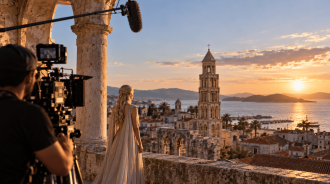
Game of Thrones may have put Split-Dalmatia County on the global film map, but it’s far from the only production to fall for the region. Over the past decade, Hollywood studios, streaming giants and international brands have all brought their cameras to central Dalmatia – turning its palaces, islands and old towns into locations for fantasy epics, musical blockbusters and hit comedies. Here are some of the most notable films and series shot in Dalmatia.
The most famous of them all, HBO’s Game of Thrones, used central Dalmatia to build the slaver city of Meereen. The underground cellars of Diocletian’s Palace in Split became Daenerys’s throne room and the dungeon where she chained her dragons, while the medieval Klis Fortress just inland served as Meereen’s exterior walls. The village of Žrnovnica and the UNESCO-listed old town of Trogir also feature, giving fans one of the highest concentrations of filming sites anywhere in the series – all within a short drive of Split.
In 2017, the island of Vis transformed into the fictional Greek island of Kalokairi for the musical sequel Mamma Mia! Here We Go Again. Meryl Streep, Cher, Lily James and a star-studded cast danced through the fishing town of Komiža, past its Franciscan monastery and old harbour, with the world-famous Stiniva cove appearing on screen. The production showcased Vis’s untouched Mediterranean character to a global audience – and turned the island into a pilgrimage site for fans ever since.
Split itself has proven remarkably versatile, often standing in for other places entirely. In the Netflix comedy Ibiza, the city was transformed into the party capital of the Mediterranean, its waterfront and nightlife doubling for the Spanish island. More recently, Split provided the backdrop for the Netflix thriller The Weekend Away, with its old town and coastline framing a story of mystery and suspense that reached viewers around the world.
The region’s appeal extends well beyond scripted productions. The hugely popular American reality series 90 Day Fiancé: Before the 90 Days spent weeks filming across Split, Omiš and Klis, reaching an audience of tens of millions per episode. International brands have followed suit: American aircraft manufacturer Cirrus chose Bol on the island of Brač – over a dozen rival European destinations – as the backdrop for a major marketing campaign, drawn by the same light and scenery that attracts filmmakers.
What unites these productions is range. Within a single county, a fantasy epic found its ancient city, a musical found its Greek island, a comedy found its party town and a global brand found its perfect coastline. As more productions discover central Dalmatia, that list keeps growing – and the region’s next star turn may be just one script away.
Planning a film, series or commercial? The Split-Dalmatia Film Commission can help you find the locations that made these productions unforgettable. Get in touch.
Most productions come to Dalmatia for the coast – the stone towns, the islands, the turquoise sea. But turn inland, and a...
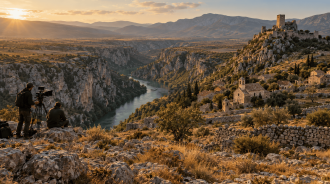
Most productions come to Dalmatia for the coast – the stone towns, the islands, the turquoise sea. But turn inland, and a completely different landscape opens up. Dalmatian Zagora, the rocky hinterland rising behind the Adriatic, offers filmmakers something the coast cannot: vast, empty karst plains, dramatic river canyons, medieval towers and stone villages where time seems to have stopped. For productions seeking raw, untamed scenery, filming in Dalmatian Zagora is one of the region’s best-kept secrets.
Zagora is a world of stone. Sweeping karst fields stretch to the horizon, framed by bare grey mountains and dotted with dry-stone walls, lonely chapels and grazing flocks. The palette is earthy and elemental – ochre, grey and gold – and the sense of space is enormous. These are landscapes that can stand in for the Mediterranean of centuries past, for rugged frontier country, or for almost any timeless, pre-industrial setting a script might require.
Because the region is sparsely populated and largely undeveloped, crews can find wide frames with no modern intrusions – no wires, no traffic, no crowds – often just a short drive from Split.
The signature natural feature of Zagora is the Cetina river. Rising in the karst and winding through a deep, dramatic canyon toward Omiš, the Cetina offers emerald water, towering cliffs and wild rapids. It’s a natural setting for adventure and action sequences – rafting, canyoning, chase scenes – as well as for serene, untouched nature shots.
The Sinjsko polje plain, the river’s valley and the surrounding gorges give productions a remarkable range of water-and-rock scenery within a compact area, from calm reflective stretches to churning whitewater.
Zagora’s turbulent history has left a rich architectural legacy. Sinj is famous for the Sinjska Alka, a knight’s tournament held since 1715 and protected by UNESCO, complete with historic costumes, horses and fortresses – a ready-made spectacle of living heritage. Vrgorac guards seven preserved Ottoman-era towers and a hilltop fortress, while stone hamlets scattered across the region preserve traditional architecture almost untouched.
For period productions, these authentic settings – equestrian traditions, fortified towers, old churches and karst villages – deliver texture and historical depth that would be enormously expensive to build from scratch.
Beyond its visual variety, Zagora offers concrete production benefits. Locations are quiet and easy to control, permits for open, publicly accessible spaces are often simpler to arrange, and there are no seasonal tourist crowds to work around. Costs for access and accommodation tend to be lower than on the coast, and the whole region lies within easy reach of Split and its airport.
Combined with the coast and islands, the hinterland means a production can shoot sea, mountains, canyons and historic architecture – all within a single county, and often within the same day.
Looking for rugged, authentic landscapes for your next project? The Split-Dalmatia Film Commission can help you scout locations across Dalmatian Zagora. Get in touch.
With more than 2,600 hours of sunshine a year, Dalmatia offers filmmakers some of the most reliable light in Europe. But choosing...
With more than 2,600 hours of sunshine a year, Dalmatia offers filmmakers some of the most reliable light in Europe. But choosing the best time to film in Dalmatia isn’t only about counting sunny days – it’s about matching the season to your production’s needs, from the quality of light and the calmness of the sea to crowd levels and location access. Here’s how the year breaks down.
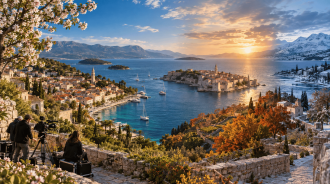
For most productions, the shoulder seasons – from April to June and again in September and October – are the ideal window. The weather is warm and stable, the sea is calm and already swimmable, and the landscape is at its most photogenic: green and flowering in spring, bathed in soft golden tones in autumn.
Crucially, these months fall outside the peak tourist crush. Locations that are packed in midsummer – Diocletian’s Palace, the old towns of Trogir and Hvar, the popular beaches – are far more accessible, permits are easier to coordinate, and accommodation and services cost noticeably less. For crews that want great light without logistical headaches, spring and autumn are hard to beat.
July and August bring the longest days and the most dependable sunshine, which can be a genuine advantage for shoots that need maximum daylight hours. The sea is warm and the atmosphere is at its most vibrant.
The trade-off is crowds. During peak season the coast and islands fill with visitors, making it harder to control busy locations, close off public spaces or move equipment through narrow old-town streets. Midday heat can also be intense, and prices for accommodation and services reach their annual high. Summer works best for productions that can shoot early and late in the day, or that specifically need the energy of the season on screen.
Dalmatia’s winters are mild by continental standards, but they offer something the summer never can: solitude and drama. Historic town centres stand almost empty, the light turns low and cinematic, and after a northern bura wind the air becomes crystal-clear, with snow often dusting the peaks of Biokovo and the Dinara mountains behind a sunlit coast.
Days are short and some weather is unpredictable, so winter demands flexible scheduling. But for productions seeking moody atmospheres, empty streets or a striking contrast of sea and snow-capped mountains, the colder months open up images that are impossible to capture in high season.
The region’s defining asset is its light. The clean Mediterranean air and the way the sun reflects off pale stone and the Adriatic give Dalmatia a luminous, high-contrast quality prized by cinematographers. The golden hours after sunrise and before sunset are especially rewarding along the coast, when the stone towns glow warm and the sea turns to gold.
Because the sea is usually calmest in the early morning, dawn is often the best moment for mirror-still water and reflective shots – before the afternoon breeze picks up.
Two local winds shape shooting conditions. The bura, a cold, gusty wind from the northeast, clears the sky and delivers spectacular visibility, but it can whip up the sea and complicate drone or boat work. The jugo (or široko), a warm southeasterly, brings humidity, cloud and rain, along with a heavier swell.
A summer afternoon breeze called the maestral is gentler but reliably ruffles the sea from midday onward – worth planning around if you need flat water. Building weather margins into the schedule, and leaning on local knowledge of these patterns, is the surest way to protect your shooting days.
Planning a shoot and not sure which season fits? The Split-Dalmatia Film Commission can advise on timing, light and locations for your production. Get in touch.
A great location is only the beginning. Turning a Dalmatian fortress, island cove or Roman palace into a finished scene takes permits,...
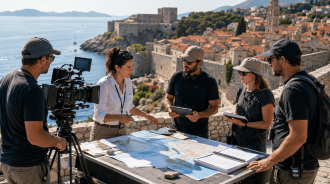
A great location is only the beginning. Turning a Dalmatian fortress, island cove or Roman palace into a finished scene takes permits, logistics, local knowledge and reliable people on the ground. That’s the role of the Split-Dalmatia Film Office — to make filming in Central Dalmatia seamless from first scout to final wrap.
The region offers extraordinary variety — medieval towns, turquoise islands, mountain fortresses, river canyons and Roman ruins, often within a short drive of one another. The Film Office knows these locations intimately, including the lesser-known ones that never appear in guidebooks, and can match your script to the right setting quickly.
Every location comes with its own permitting authority — municipalities, the Ministry of Culture, park administrations, port authorities. The Film Office coordinates these approvals in parallel, prepares applications, and handles specialised permissions such as drone and maritime filming, so productions avoid bureaucratic delays.
Experienced local crews, equipment providers and hospitality partners can make or break a schedule. The Film Office connects productions with trusted local professionals who know the terrain, the weather patterns and the practicalities of shooting on the Dalmatian coast.
From accommodation and transport to base camps and access arrangements, the details matter. The Film Office provides logistical support tailored to each production, drawing on established relationships across the county.
Perhaps the greatest advantage is simplicity: instead of navigating multiple authorities, vendors and unknowns, productions work with a single, knowledgeable partner. That’s what turns a complex international shoot into a manageable one — and it’s why productions keep returning to Dalmatia.
Planning a film, series or commercial in Central Dalmatia? Get in touch with the Split-Dalmatia Film Commission and let’s bring your project to the screen.
Dalmatia’s islands offer something increasingly rare in Europe: coastlines that still look untouched. Beyond the well-known names lie coves, stone villages and...
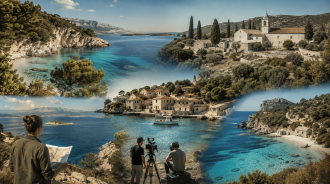
Dalmatia’s islands offer something increasingly rare in Europe: coastlines that still look untouched. Beyond the well-known names lie coves, stone villages and dramatic bays that most productions have never seen. Here are five island locations worth putting on your scouting list.
When Mamma Mia! Here We Go Again needed an idyllic Greek island, it chose Vis. Cut off from foreign visitors for decades as a military zone, Vis preserved an authentic Mediterranean character — hidden coves like Stiniva, the fishing village of Komiža and the glowing Blue Cave nearby. It remains one of the most cinematic islands in the Adriatic.
Directly opposite Split yet remarkably quiet, Šolta has fewer than 2,000 year-round residents. Stone villages, olive groves and pristine coves like Stračinska make it ideal for productions wanting island authenticity without long travel from the mainland.
On Brač, the town of Pučišća wraps around a deep, fjord-like bay and is built almost entirely of gleaming white Brač stone — the same stone used for Diocletian’s Palace. Its stonemasonry school and Renaissance Aquila tower give it a distinctive, luminous look found nowhere else.
Also on Brač, Selca combines a dramatic coastline of hidden turquoise coves with striking architecture: the 45-metre Church of Christ the King, the tallest on any Dalmatian island. It’s a location that offers both nature and monumental scale in one place.
One of Croatia’s smallest towns, Sutivan sits on Brač facing Split, with a 6th-century church, a fortified tower and an intimate stone harbour. For scenes needing a compact, authentic island setting with easy ferry access, it’s hard to beat.
The islands that made Mamma Mia 2 and countless other productions look effortless are only the beginning. Dalmatia’s archipelago holds dozens more locations waiting to be discovered — and a local film office can open the doors.
Ready to explore Dalmatia’s island locations? The Split-Dalmatia Film Commission can help you scout and plan.
Croatia has become one of Europe’s most sought-after filming destinations, and Dalmatia sits at the heart of that appeal. But before the...
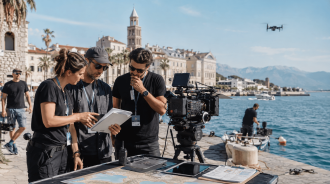
Croatia has become one of Europe’s most sought-after filming destinations, and Dalmatia sits at the heart of that appeal. But before the cameras roll, every production needs the right permissions in place. Here’s how the process works — and why it’s more straightforward than many productions expect.
Everything begins with location. Whether you’re filming in a public square, a national park, a UNESCO-protected old town or on the open sea, each type of location has its own permitting authority. Historic sites, protected nature areas and public spaces each require separate approvals, so an early, accurate location list saves significant time later.
Depending on where you shoot, permits may be issued by the local municipality, the Ministry of Culture, a national or nature park administration, or port authorities for maritime scenes. Coordinating several authorities in parallel is normal for larger productions — and it’s exactly where local knowledge makes the difference.
Croatia offers a cash rebate of 25% on qualifying local spend, rising to 30% in certain cases. Administered through the Croatian Audiovisual Centre (HAVC), the incentive applies to a wide range of production costs and is one of the most competitive in the region. Applications should be prepared early, as they run alongside — not after — your production planning.
International productions rarely navigate this alone. A regional film office or experienced fixer can bundle the entire process — mapping locations to the correct authorities, preparing applications, arranging maritime and drone permissions, and connecting you with local crew who know the terrain.
Filming in Dalmatia is far less bureaucratic than its layered heritage might suggest — provided you start the permit process early and lean on local expertise. Get the paperwork right, and the region’s Roman palaces, island coves and mountain fortresses are yours to film.
The Split-Dalmatia Film Commission handles permits, logistics and local connections so your production can focus on the work. Contact us to get started.